
Rustic Rye Sourdough Bread Recipe
By Amanda Paa – Updated October 31, 2023
Jump to Recipe
This post may contain affiliate links. Please read my disclosure policy.
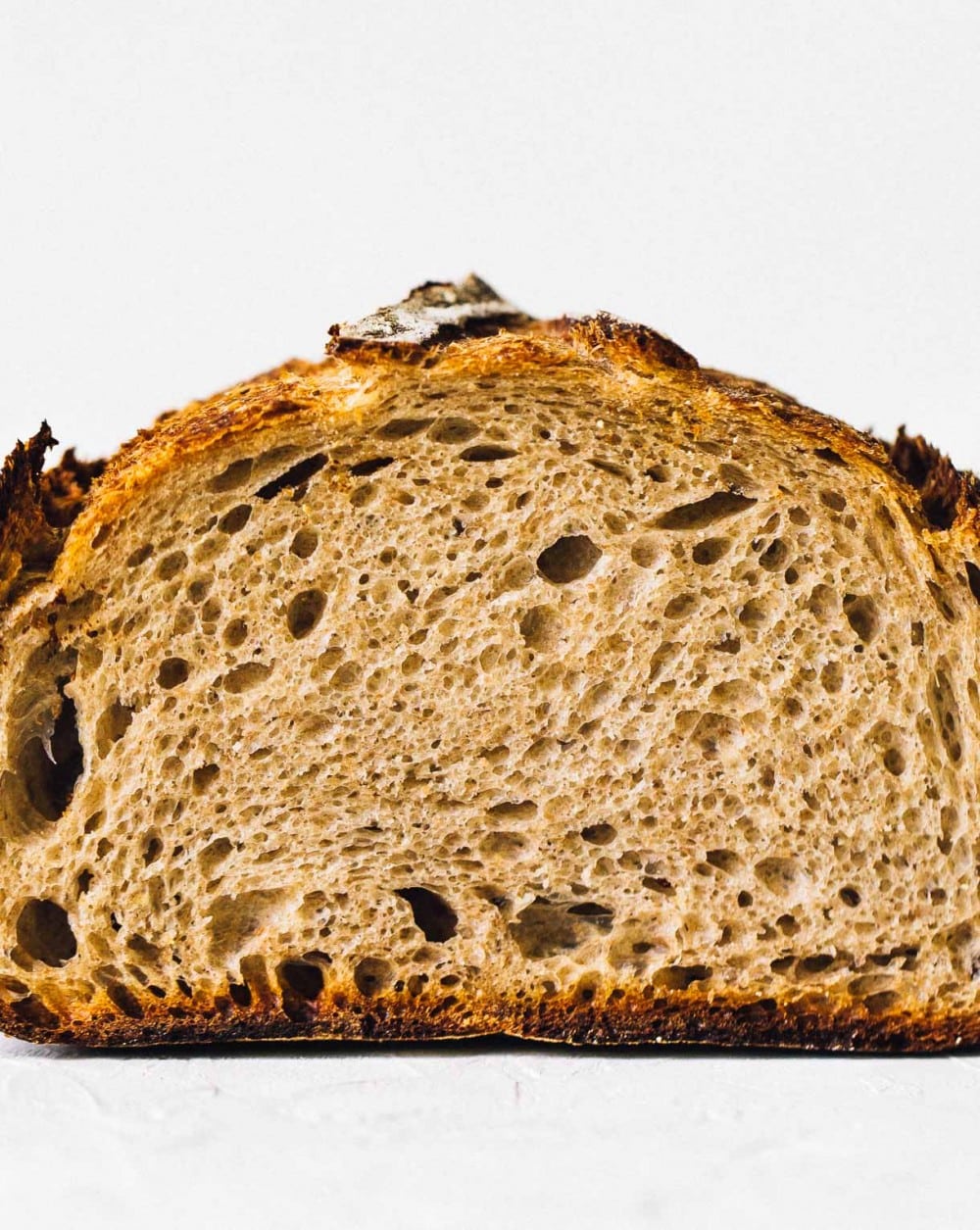
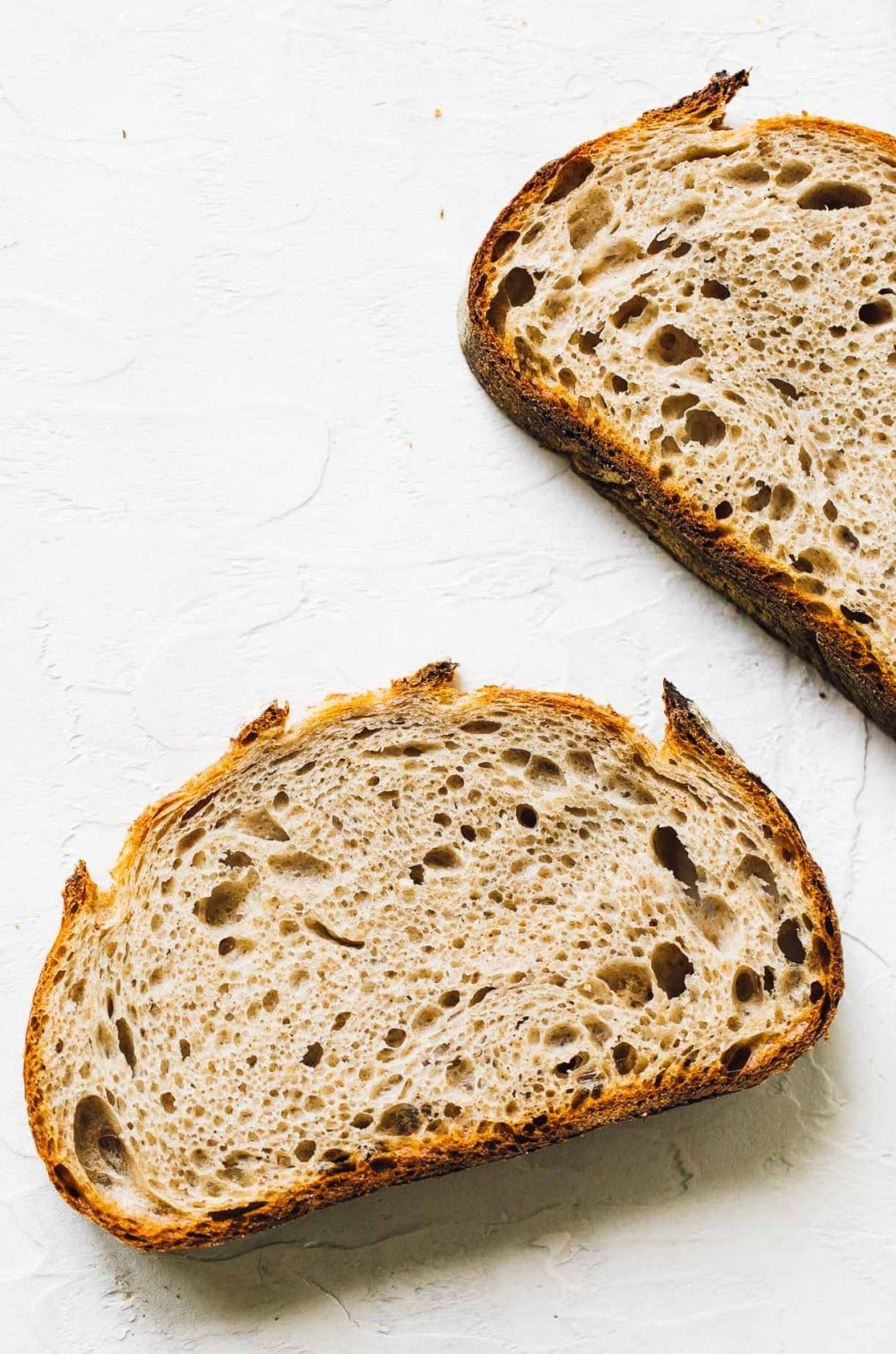
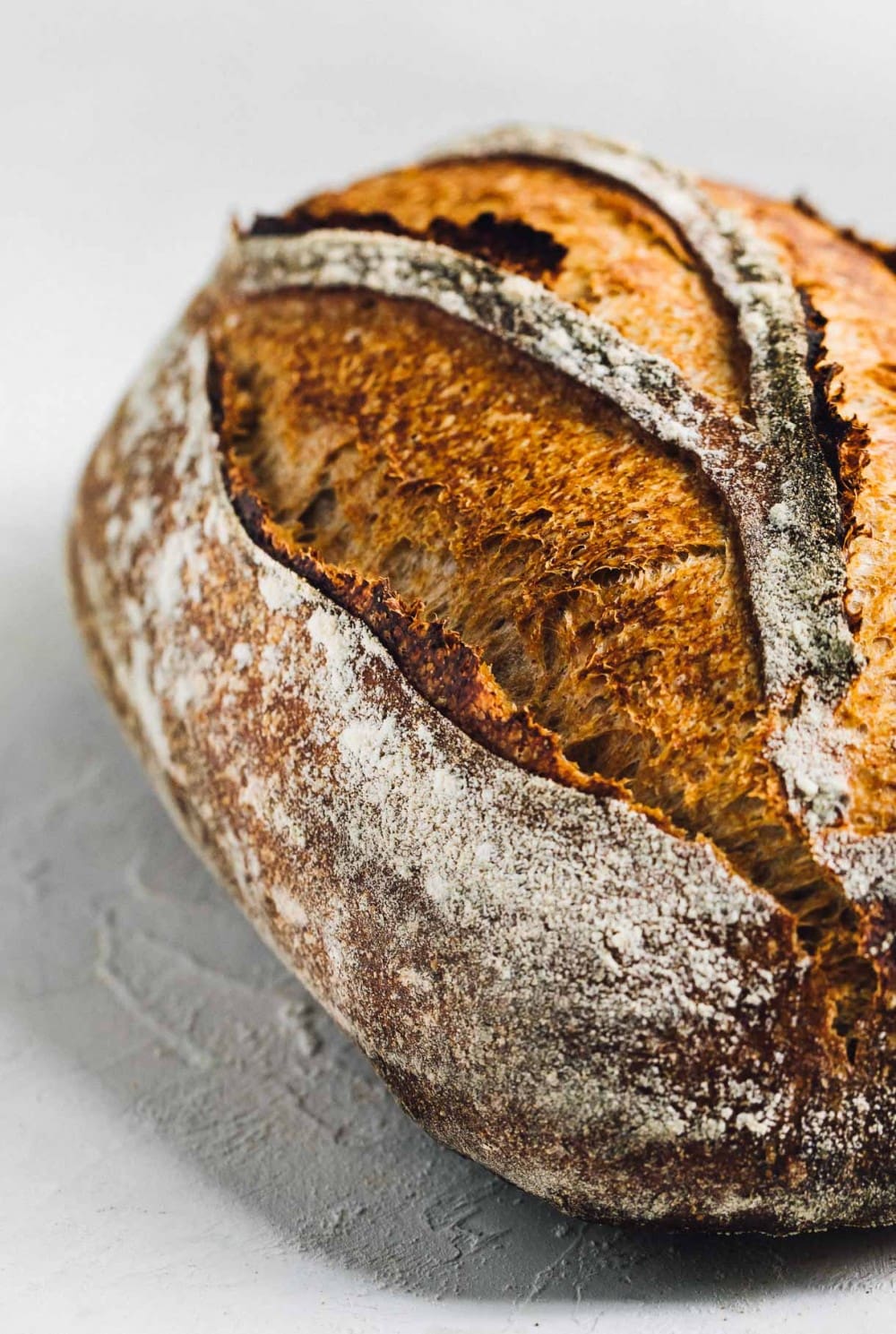
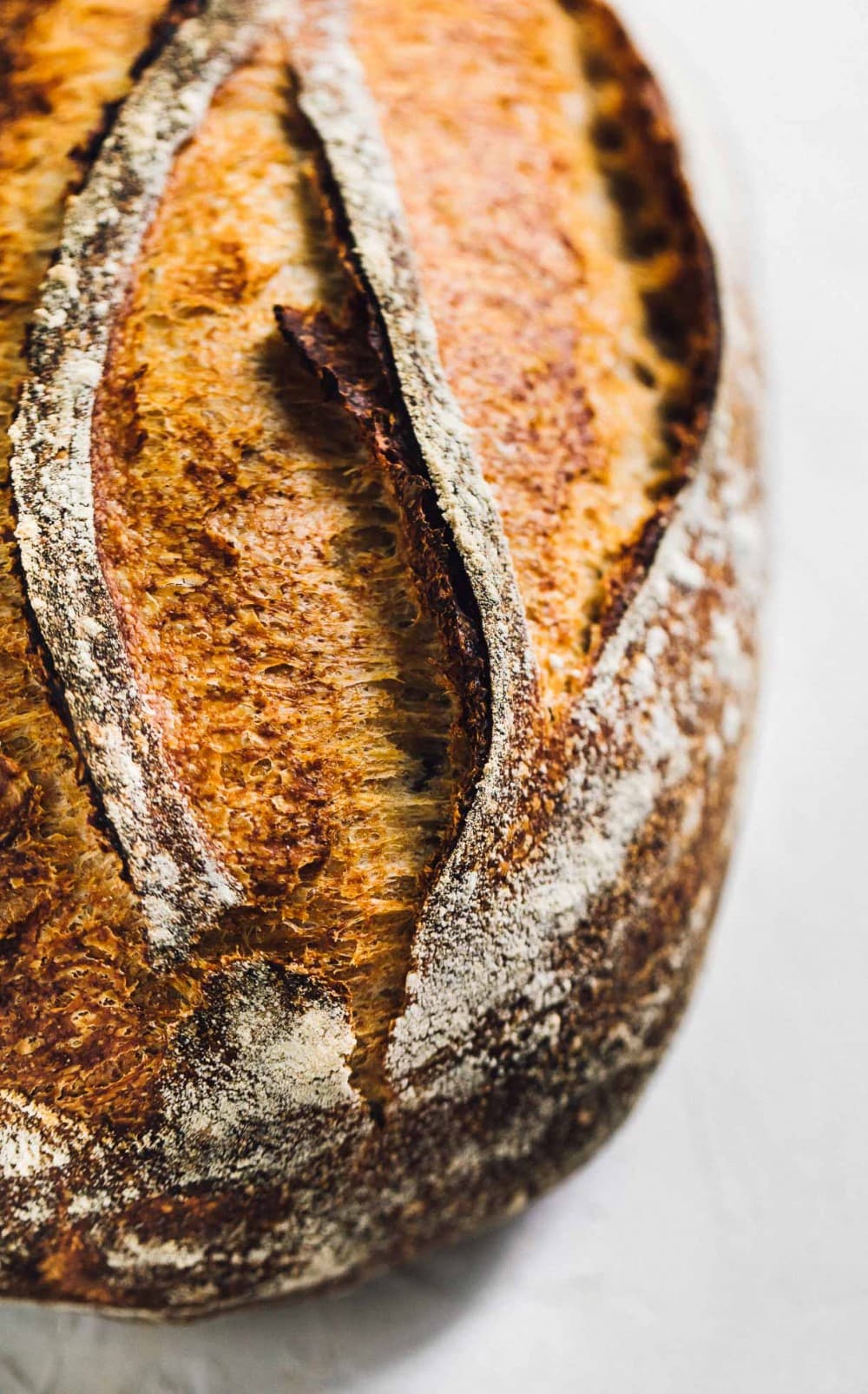
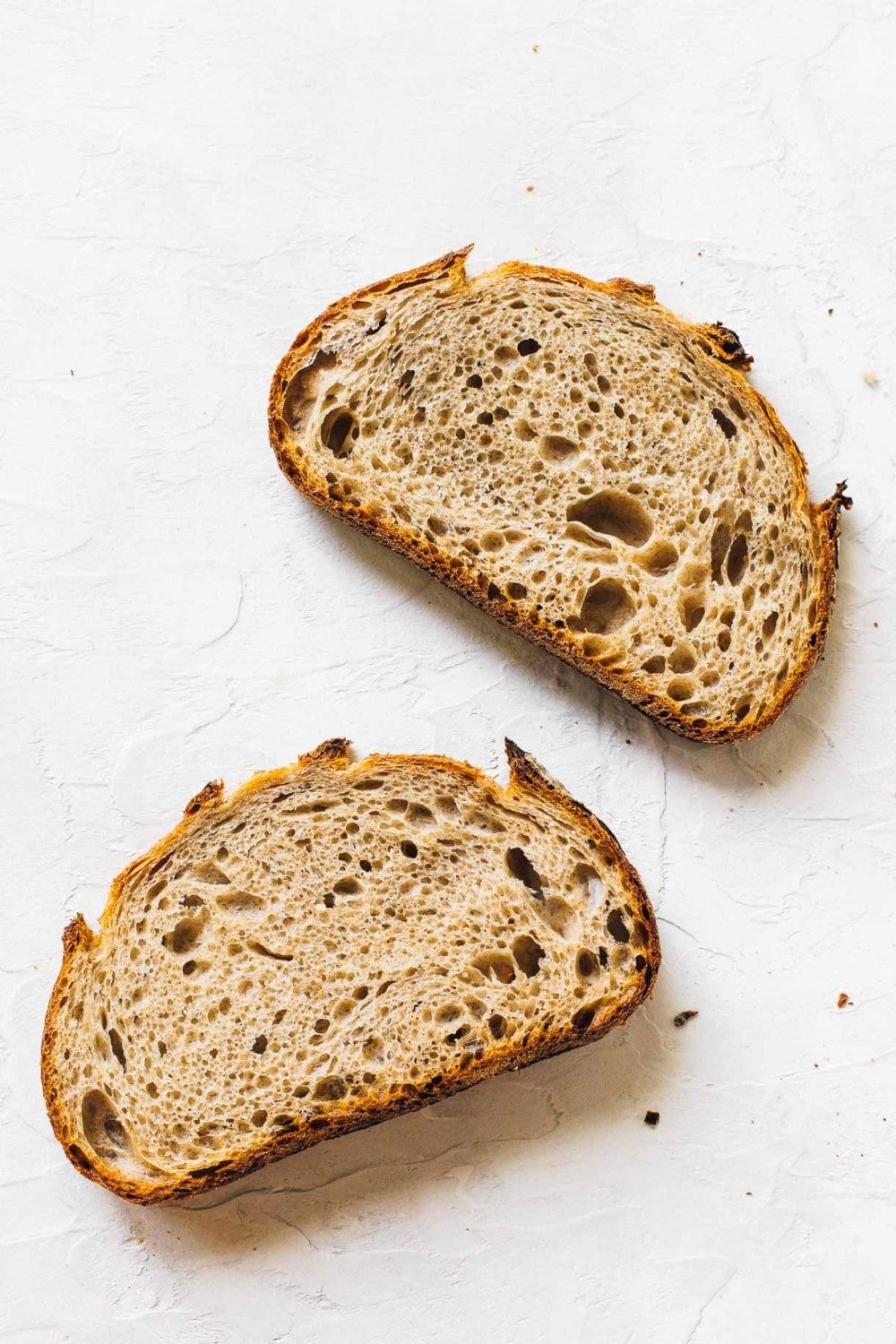
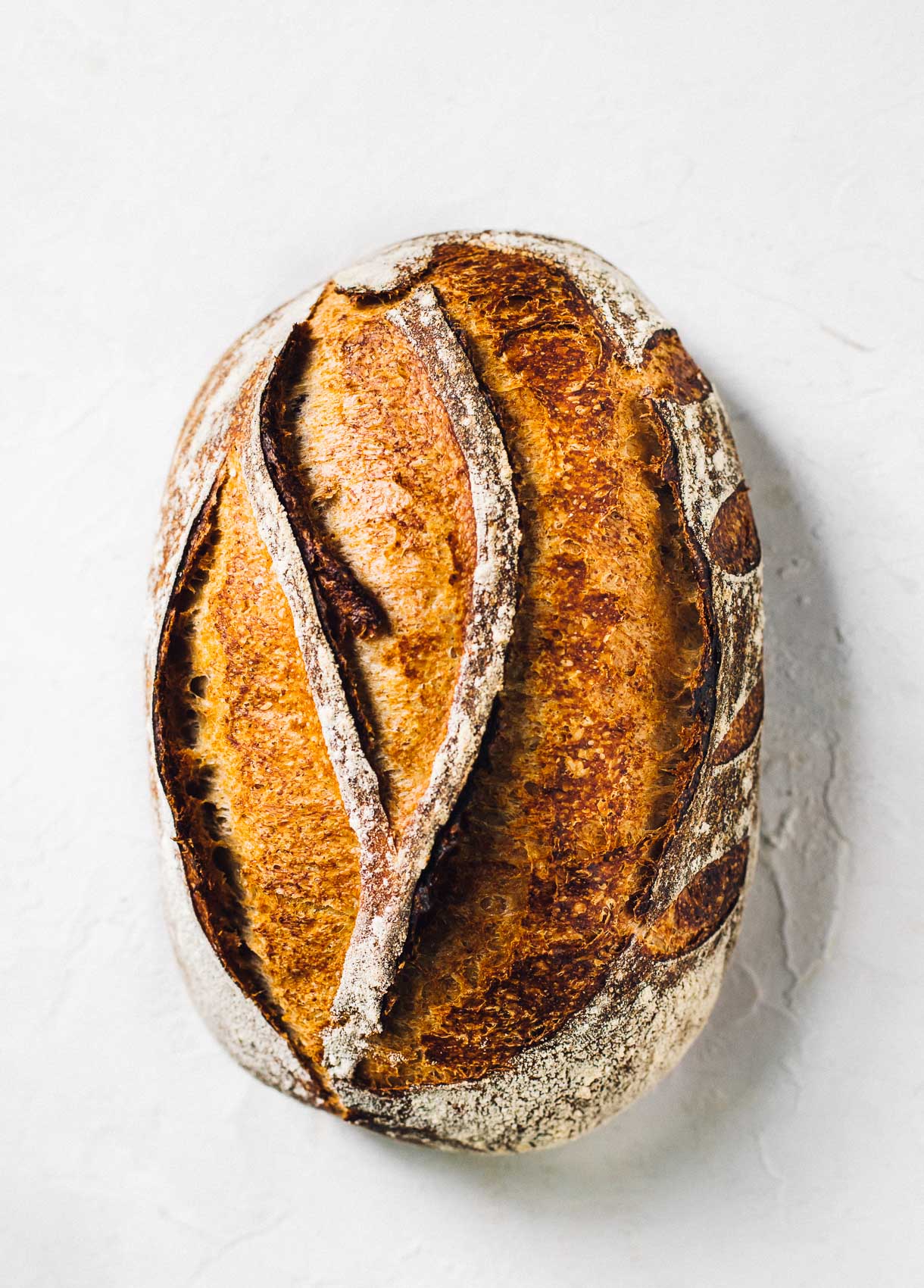
Homemade rye sourdough bread is a glorious choice for sandwiches, or eating on its own. Made with a blend of whole wheat, bread flour, and rye flour, this naturally fermented loaf holds its shape and has a moist, chewy crumb. The rustic crust is deeply colored and boasts beautiful blisters!

New to sourdough baking? You’ll need an active sourdough starter! I ship my well-maintened 13+ year old starter to anyone in the U.S! You can ORDER it here.
A great deli has a great rye bread for sandwiches, am I right?
I certainly love my Everyday Sourdough recipe for toast and my sourdough english muffins for epic breakfast sandwiches, but I had my heart set on creating a loaf that was the perfect vehicle for my recent craving of EGG SALAD. I’m fully aware how strange this craving is, but let me tell you, when I piled it on this rye sourdough with crisp lettuce and pickled red onions – it was a joyful moment.
This rustic rye sourdough is called such because of its crisp, deeply browned crust and artisan sourdough shape, rather than baking it in a pullman loaf pan to get perfectly square slices for sandwiches. I might invest in one of those in the future, but for now, I wanted to share a sandwich bread recipe that you could make with your regular sourdough baking tools.
It’s hearty. Has substance. A pleasant tang. And a shatteringly crisp crust.
What is rye?
Rye is a type of grain, different than wheat, that contains a low amount of gluten. This means it will not create the same gas trapping air pockets that a bread made entirely of bread flour does.
The dough will also feel wetter and stickier compared to working with all purpose and bread flours, known as high gluten flours. Don’t be alarmed – the dough will become less sticky by the end of your stretch and folds. Knowing this before making this recipe is important.
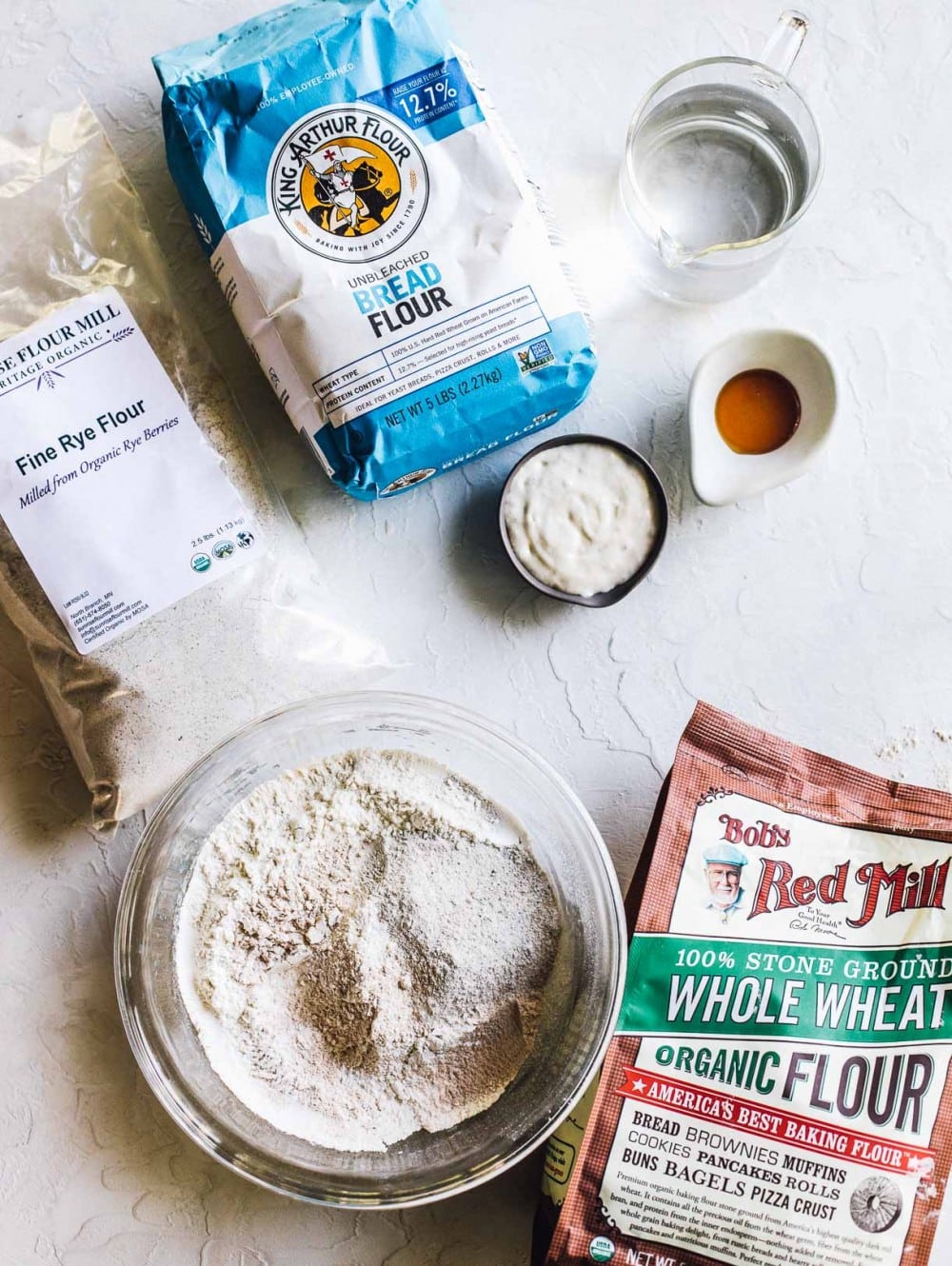
For these reasons, I like to use rye in combination with bread flour, for a balance of high/low gluten percentages. This allows for excellent structure in the loaf, while the rye contributes a complex flavor and wonderful softness.
Why I love using rye flour in sourdough bread
- Complex flavor!
- Rye flour bodes particularly well to sourdough as it’s unique fruity, subtle sourness compliments the traditional notes of fermented bread.
- Less dense than traditional rye bread.
- Because of the chemical reaction that takes places in rye flour during fermentation, your loaf will be airier and fluffier than if you were to use rye flour in a bread made with commercial yeast.
- Bread has a moist, chewy texture that you can’t achieve with whole wheat.
- Because of rye’s ability to absorb and keep much of it’s moisture, the inside of a sourdough loaf made with rye flour will have a more moist texture.
- Your loaf will stay soft for several days after baking!
- Higher nutritional profile that whole wheat.
- Rye contains more nutrition than wheat flour does, and this is especially true when rye flour is added to sourdough bread. The slow fermentation increases the nutrient availability of the flour.
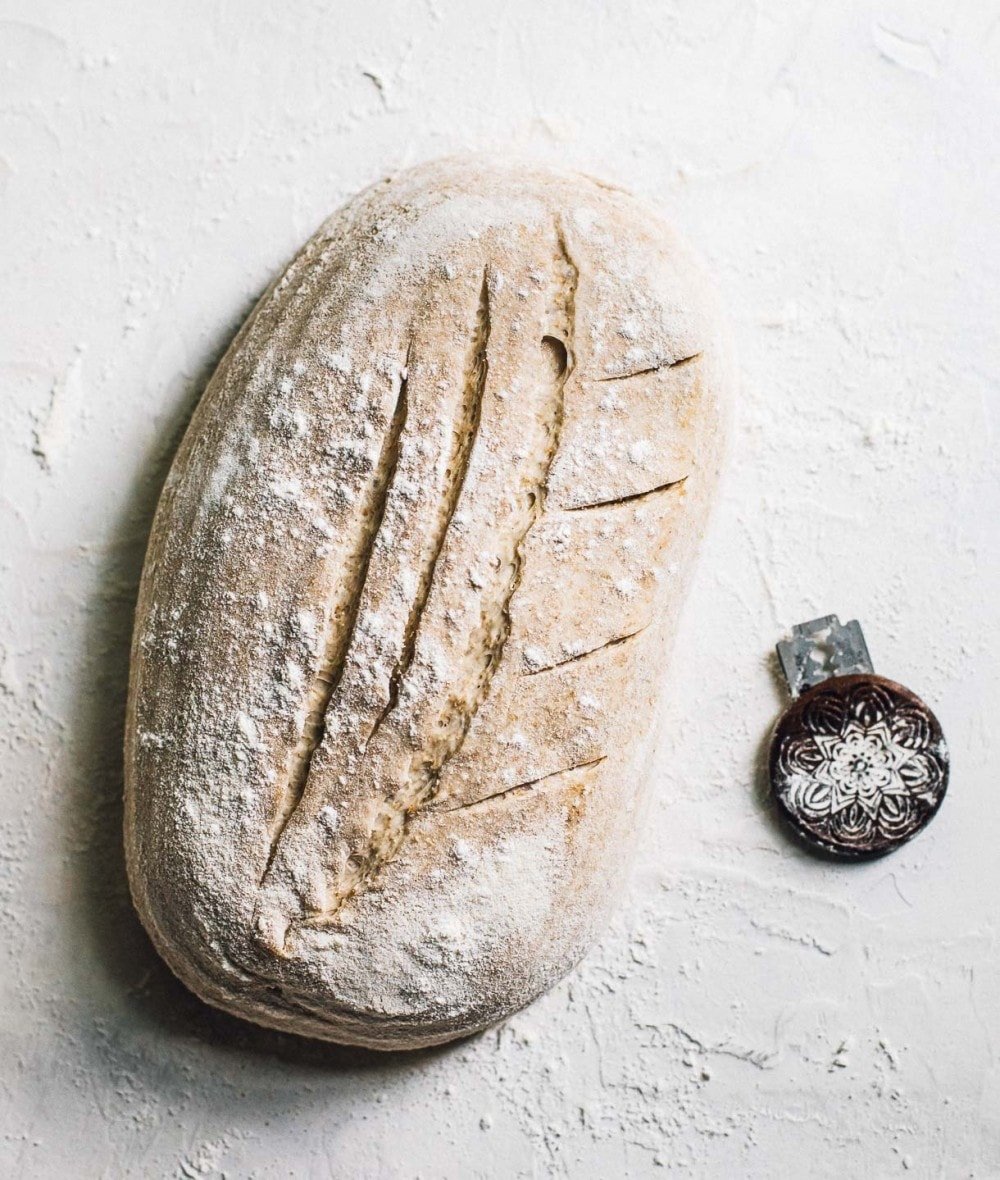
How to make rye sourdough bread that holds its shape
Because rye flour has little to no gluten content, it’s difficult to make a loaf of 100% rye bread. It can be done, but I wanted this to be a hybrid loaf, that would hold it’s shape for you, and still achieve a nice rise.
That’s why I used bread flour in combination with the rye and whole wheat, because it’s higher protein percentage is the key to the loaf holding its shape.
You’ll also notice this is a slightly smaller loaf, which makes the slightly wetter dough more manageable. Yes, you’ll notice the dough is slightly wetter than other sourdough bread you’ve made, and that’s okay! Just keep going with it. It will bake up with great structure if properly fermented.
WATCH this short video to see all the steps of making rye sourdough, so you know what to expect from your dough.
What should I bake an oval loaf in?
I tried using my round dutch oven for baking oval loaves in the past, but without fail the edges of the dough with hit the side of the pot, creating wonky, bulged shapes. I’m newly in love with the Challenger Bread Pan, which has a unique shape that allows you to bake any shape of bread in it! Bâtards, boules, demi-baguettes, and other loaves of almost any size.
Because of how it’s made, the perfect amount of steam is created inside the pan. I’ve never had better oven spring or thinner crusts.
This pan is magical. If you love baking sourdough, it is 100% worth having in your kitchen. You can learn more and purchase here.
My favorite things to eat on rye bread:
- egg salad
- whipped feta and tomato jam
- smashed avocado + lemon + smoked paprika
- ricotta + strawberry rhubarb jam
- salted butter
More sourdough recipes:
Yield: 1 loaf
Equipment
- oval banneton (can also use round)
Ingredients
- 55 grams active sourdough starter
- 280 grams slightly warmer than room temperature water (about 80-85 degrees F)
- 15 grams honey
- 100 grams medium (or light) rye flour
- 260 grams bread flour
- 40 grams whole wheat flour
- 7 grams fine sea salt
Instructions
- Before beginning, it will be helpful to watch this SHORT VIDEO to see me make this bread, noticing that the dough will be stickier than normal because of the rye flour, but it will come together – you just have to trust!
- Add starter, water, and honey to a bowl. Whisk thoroughly until combined, with a fork. Add flours, and mix together first with the fork to start to incorporate, then with your hands until a shaggy dough is formed, and the bits of flour left just disappear. Sprinkle the salt on top and do not mix in, just leave it on top. Cover with a damp cloth.
- Autolyse: let dough sit for one hour, covered and undisturbed.
- Bulk ferment: Now you will knead the salt that is sitting on top, into the dough for about 2 1/2 minutes. There is no precise way to do this, just think of working the dough through your hands and up against the bowl, push and pull. You will start to feel the dough relax a bit around 1 minute. Then leave the dough alone, covered, for 30 minutes. This counts as your first set of stretch and folds.
- After those 30 minutes pass, perform a set of stretch and folds. Repeat 2 more times.
- Now you will let sit, undisturbed and covered with a damp cloth, for the remainder of its bulk fermentation. You will know it is finished with its bulk ferment when the dough has risen about 75% (just short of doubling) in size, is smooth and puffy on top, with a few bubbles around the edges. It will not be as jiggly as some sourdough you've made before. I find this takes between 5-7 hours, depending on the temperature of your home. If the temperature in your home is above 72 degrees, this will be on the lower end; if it is cooler it will take on the longer end. Always go by the look and feel of your dough to know when it is finished proofing rather than time.
- When finished with bulk fermentation, lightly dust your work surface with flour. Put dough onto the work surface, and pre-shape. Then let sit for 15 minutes on your work surface.
- Then shape your dough using the video attached here as a guide.
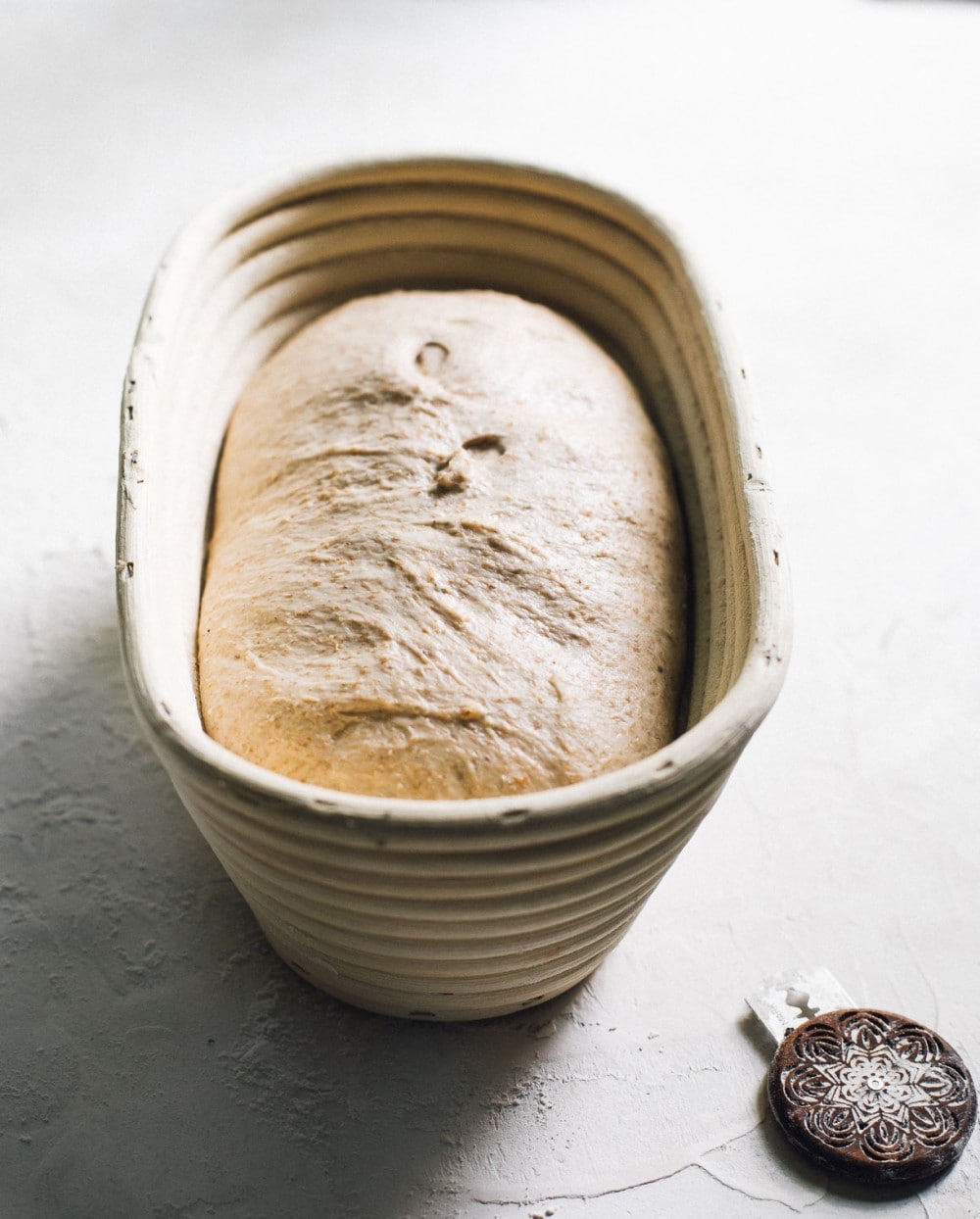
- Place dough into your flour dusted banneton, (or flour dusted linen lined banneton) seam side up. (Optional, you can wait 15 minutes after placing it in banneton, and pinch the perimeters of the dough into the center to hold the shape even more, called stitching.) The dough will now go through its final rise. You can do this on the counter, which will take about 1 1/2 to 2 hours at 70 degrees F for the dough to puff up and be jiggly. It will not double. OR you can do the final rise overnight in the refrigerator, with the banneton covered in a plastic bag or with a very damp cloth. You need this for holding moisture in.
- Time to bake. Preheat your oven to 475 degrees F, with your dutch oven preheating inside the oven. When the oven is preheated, flip your dough out gently onto parchment paper and score your dough. If you did the final rise in the refrigerator, take it straight from fridge to scoring. You should score it cold, and DO NOT need to let it come to room temp.
- Then put scored dough into the dutch oven on the parchment, and put cover on. Turn oven down to 450 degrees F and slide dutch oven in. Bake for 20 minutes, then remove cover.
- Turn heat down to 430 degrees F, and bake for 20 to 25 more minutes, until crust is golden brown and crackly. Remove from oven, and remove bread from dutch oven and place onto a cooling rack.
- Wait AT LEAST one hour to cool otherwise, the interior will be gummy.
Did you make this?
tag @heartbeetkitchen on instagram and hashtag it #heartbeetkitchen
June 12, 2020

Judy
June 23, 2023
Just tried this recipe for the first time. The instructions were clear and easy to follow, and most importantly – they made it easy for me to calculate a timeline that worked for me. And it was delicious! This recipe makes a perfect size loaf for 2-4 people, and was a big hit at my small dinner party! I doubled the recipe (or more accurately I made two at a time in separate bowls) and I’m thrilled to have a second loaf already made and frozen for future enjoyment!
Thank you Amanda!
Amanda Paa
June 23, 2023
I’m so glad you enjoyed it Judy! And awesome that you worked ahead with the double recipe.
Jk
June 17, 2023
Can I use molasses instead of honey?
Amanda Paa
June 17, 2023
Yes you can! As long as you enjoy the flavor of molasses (it will not be strong, but just is different than honey).
Jennifer
June 13, 2023
Is it ok to use dark rye flour in place of the light rye flour?
Phaedra
June 5, 2023
Yum! After baking how do I store it?
Amanda Paa
June 6, 2023
Hello! I like to store it cut side down on the counter top, covered with a linen for the first day. Then I use a plastic bag to store it.
Kathleen Greene
May 18, 2023
I would like to wait two days to bake the loaves that are fermenting this afternoon. Would you recommend almost two days in the fridge, or freezing them, or serving guests day-old bread? (I made this recipe a few weeks ago and it was fabulous!!) Thanks!
Amanda Paa
May 19, 2023
Hello! You could bake and wait to cut into until your guests are there, or bake, let fully cool, and freeze. Then take out to dethaw and warm in a 250 degree oven.
Christine Baker
May 17, 2023
Great recipe!
I’m still struggling to adapt to dutch oven, keep burning it, but it’s still the best bread I had in many years.
Unfortunately on the phone I can’t find the recipe anymore. Is there any way to add a BACK button for mobile browsing?
I wish I could post the recipe on FB and at my blog, but I don’t want to cause my readers the frustration I’ve been experiencing. Running back and forth to my computer is nightmarish. It’s NICE to have the recipe on the phone in the kitchen right there, as I had it on the phone once, but can’t find it again. 21st century tech: no way to get BACK.
Barbara K.
May 15, 2023
Thank you for an easy-to-follow recipe. The bread tastes great. But next time, I will adjust the baking time to 30 minutes with the lid on, and 12-15 min without. The crust browned too quickly, almost burning at the bottom.
Amanda Paa
May 15, 2023
So glad you enjoyed it, Barbara! Yes, every oven is different so I think your adjustment will work well.
Barbara K.
May 18, 2023
I’ve adjusted the time, and the bread came out perfect. Or almost perfect. I had a very active starter (as in, it wanted to escape from the jar) and decided to use King Arthur’s Super 10 Grain instead of rye flour. The first rise only took 6 hours because of the temp in my house, and I did the second in the fridge for about twelve hours. But the bread came out flatter than with rye flour, and I suspect that something in the Super 10 Grain blend impedes its rise (I had the same issue with another recipe for Pullman Pan). The taste is wonderful, but I wonder if I can do something to get a higher loaf?
Amanda Paa
May 18, 2023
Hi! Yes, the 10 grain will be a different protein percentage than rye, so more strength would need to be built and the hydration would likely need to be adjusted for the proper rise.
Jacob O'Brien
May 8, 2023
Have you tried this recipe with a higher levain percentage like 20%? I usually make 80% bread flour 20% white whole wheat sourdough with a 20% levain. Usually only 3.5-4 hour bulk fermentation. Trying to make this in the same time frame as my usual loaves!
Amanda Paa
May 9, 2023
Hello Jacob! I haven’t tested this with a high levain percentage, since I like the slower fermentation for the flavor it imparts. But I think you could safely go up to 15% and maybe decrease water by 15 grams.
Margie
May 6, 2023
I am relatively new to sour dough but I have made this recipe 3 times, and each time it turns out beautifully. This is a 5 star rating, because it turns out and the instructions are really great. I followed the instructions exactly.
This recipe makes 1 loaf. I have increased the batch to 9 loaves once, and 6 loaves another time. It was a bit overwhelming to stretch and fold when the batch was 9 loves, but worked perfectly at 6 loaves. A good weigh scale and using a starter at its highest active state is critical. Testing the starter to see if it floats is a great way to determine if the starter is active enough.
I increased the whole wheat and it worked really well. I used the exact rye flour as the recipe but increased whole wheat to 170gms and decreased bread flour to 140gm ( per recipe). I also had to proof it longer because the dough is heavier ( 7 hours at room temp and 7 hours in cool room 12 degree c) …to get the double in size rise. This made a lovely deeper sour taste as well. Once I had the loaves in the bannetons the dough rose nicely in 2 hours at room temp ready for the oven. Using a sharp razor blade or scoring tool is important.
Amanda Paa
May 7, 2023
Great, so glad you enjoy this recipe! And wow, very impressive making 9 loaves at once. Thank you for the notes!
Hilary
April 23, 2023
Hi! I really want to try this recipe and I have a question about the starter. I normally keep my starter in the fridge because I don’t bake that often. Will I need to keep it out for a few hours before doing the recipe or any special treatment?
Amanda Paa
April 25, 2023
Hello Hilary! I would recommend going through 2-3 feedings before using your starter for baking. Since it’s stays dormant in the fridge, it will need to be activated. You want to use a lively, active starter for best results. There are also tips for maintaining and feeding a sourdough starter here.
Dan
April 11, 2023
Hi, very nice website. I’ve been making bread like this for years and just stumbled across this. The proportions are very similar to mine and I was simply wondering what hydration this recipe had, and had to take out my calculator to figure it out. For bread makers, it would be be nice (if not polite) to state the ingredients in bakers’ percentages. At least you didn’t use volume measurements or I wouldn’t be here. Your scoring is what caught my eye. Keep up the good work! -Dan
Jim
April 10, 2023
I just made the bread this past weekend and it was really good. Nice crispy crust and light flavorful open crumb. I saw another comment concerning caraway seeds and you stated add them during the third stretch and fold. How many seeds do you recommend?
Mary
April 8, 2023
I tried this recipe for the first time yesterday (baked this morning), and am thrilled with how well it turned out! Really delicious and I’m very pleased with the crumb I got as well! Thanks for such a great, easy to follow recipe
Amanda Paa
April 8, 2023
Your photo of it on Instagram was lovely, great bake! I’m so glad you liked the recipe.
Holly
March 22, 2023
SO good! And I don’t even like rye bread 😜 this is such a beautiful loaf. The flavor and texture are perfect and the step by step instructions were easy to follow.
Amanda Paa
March 22, 2023
Yay! Your photo of the bake on Instagram was beautiful.
Melvin Hildreth III
March 18, 2023
Hi I’ve been baking bread for a year now. It took me six months to finaly get the perfect sourdough loaf bahaaa, Really it did. Your recipe is awesome. I use a enamel coated cast iron pan I got on Amazon for just under $50 but I have since found two better pans one for $60 and the other for $65 great price and the one is just like the challenger. here is the other one that is enamel coated it’s really nice. Thanks for the recipe. My family loves the breads I have learned to make. Have a beautiful day!!
Amanda Paa
March 19, 2023
I’m so glad you like this rye sourdough recipe! And thanks for the notes on the baking vessels.
James
March 17, 2023
I just made this for St Patricks Day. Nice ratios. The dough behaved perfectly.
Amanda Paa
March 17, 2023
I’m so glad you liked it, James!
Jeanne
March 12, 2023
Question about the two bulk ferments, can they both be done in the refrigerator overnight?
Amanda Paa
March 12, 2023
Hello! The bulk fermentation should be done on the countertop, the final rise (fermentation) in the refrigerator overnight.
Connie
March 12, 2023
Very good!
Kari
March 9, 2023
This is our favorite loaf. Perfect for sandwiches. I love the texture and taste of the rye flour. Will be making again.
Amanda Paa
March 10, 2023
I’m so glad you like it, Kari!
Michelle
March 9, 2023
I live in Colorado Springs and I know the high altitude can affect baking. I substituted the whole wheat flour for more Rye because I don’t have whole wheat. Idk if that is why my dough seems so dry. I have added a little more water as I knead. But my bread doesn’t stretch and melt like your dough does in the video. It just stretches a bit then tares. Any ideas?
Amanda Paa
March 9, 2023
Hello! Whole wheat flour and rye are not interchangeable, which is why your outcome will be different than the recipe as written.
Patricia
March 3, 2023
Hi! Looking to complete this bread. Was just wondering if the honey was necessary for the formation of the bread. I’d rather do without it, if possible. Any tweaks that I will need to do if I omit it? Looking forward to making this tonight. Thanks!
Amanda Paa
March 3, 2023
Hello! The honey serves the purpose of balancing the bitterness of the rye grain. In testing, I thought this was the best representation of the bread. You can omit if you prefer.
Rachel Powers
February 28, 2023
Really glad I stumbled upon this website on my search for sourdough recipes. Amanda has a way of explaining the recipes that often feel daunting or intimidating for beginners so that they feel approachable and user friendly. When it comes to working with sourdough, I am very much still a novice and for this reason I really appreciated all of the additional tips and resources. My first time with this recipe was a huge success. I loved the long fermentation process. It truly adds a whole new level of that rustic sour flavor I adore. I can’t wait to check out more of her recipes!!
Amanda Paa
February 28, 2023
I’m so glad you’re enjoying the sourdough journey! The rye loaf you baked was beautiful, thank you for sharing a picture of it on Instagram!
Cindy mays
February 26, 2023
Quick question for you before I start this recipe … I have tons of flour types on hand. Which could I try without buying more. My choices I have are white wheat pastry flour, spelt berries I can grind with my mill or spring red wheat I have to also grind. Keep in mind I already will be using bread flour and the rye. Which would be the best do you think as my third choice here? I have to use up what’s in hand and would love your input
Amanda Paa
February 27, 2023
Hello! If you do not have whole wheat, use the spring red wheat you have on hand that you can grind. It will turn out lovely!
Candice
February 26, 2023
This recipe is amazing. So well written and turns out great every time!
I like to add a tbsp of caraway seed when mixing in the salt. I often add a ice cube to the Dutch oven when baking to give a little lift and crust.
Amanda Paa
February 26, 2023
Your photos of your bake on Instagram was so beautiful! I’m glad you are enjoying this rye sourdough.
Debra
February 17, 2023
Really delicious loaf with bold flavor. I added caraway seeds after reading some comments and put them into the 3rd stretch and fold. It’s a tad smaller than other loaves I’ve made (400 grams instead of 500) also had less starter, other recipes I’ve used had around 100 grams of starter but it definitely works well so I can’t argue with that. Perhaps I’d double the recipe if I made this for more than me and my husband. We polished off the whole thing pretty quickly.
I appreciate the step by step clear instructions. I’ll definitely make this again.
Amanda Paa
February 17, 2023
Hi Debra! So glad you enjoyed the recipe. Yes, the smaller amount of starter extends fermentation time to give it a deeper flavor. Using more starter results in a dough that ferments faster therefore less time for flavor to develop in the bread.
Mark Tantillo
February 17, 2023
I made this and I’m very happy with how it turned out. It’s a beautiful looking loaf as well it’s delicious. Thank you for sharing. I have shared with two friends as well.
Amanda Paa
February 17, 2023
So glad you are enjoyed the Rye Sourdough, Mark! And lovely that you have shared with friends.
Ang
February 19, 2023
Hello,
Can I use my stand mixer to knead the dough?
Amanda Paa
February 19, 2023
I haven’t tested this with a stand mixer, sorry!
Natalia
February 15, 2023
This bread is delicious, I have memorized the measurements and make it weekly. Sometimes I make 1.5 times the amount and split it into 2 loaves, one for us and another one for my mom. I have found that cold proofing for 2 days make it even more delicious. Thank you for a great recipe.
Amanda Paa
February 16, 2023
So great, Natalia! I’m glad you are enjoying the rye sourdough.
Gabriela
February 13, 2023
absolutely amazing! thank you for this recipe
Amanda Paa
February 13, 2023
So glad you enjoyed it, Gabriela!
andrea
February 9, 2023
Help please! I accidently put some chia seeds in my starter. I weighed out by discard, and then added some seeds to them. Crazy distracted me. Any suggestions if I should throw the discard out or should I continue to feed the starter?
Amanda Paa
February 9, 2023
Are the chia seeds sitting on top, or stirred in? If on top scoop chia seeds off, and just keep 2 tablespoons starter and feed as normal.
andrea
February 10, 2023
Thank you Amanda for responding to my pleas for help. I was only able to save 16 g of starter that didn’t have chia seeds mixed into it. What do you suggest I do next?
Many thanks,
andrea
Amanda Paa
February 11, 2023
16 grams is great! That’s all you need. Start feeding 35 g flour and 35 g water, and increase feeding amounts as needed.
andrea
February 13, 2023
Thanks so much! I very much appreciate your support.
Nadia
February 6, 2023
Absolutely love this recipe! Made it twice now and it turned out PERFECT every time!!!
Amanda Paa
February 6, 2023
Your video of your bake on Instagram was beautiful!
Katherine
February 5, 2023
Hi. Can I sub white whole wheat flour for the whole wheat flour?
Amanda Paa
February 5, 2023
Yes, White Whole Wheat can be used for the Whole Wheat!
White whole-wheat flour is simply made with a different variety of wheat. It’s made with hard white spring or winter wheat — the bran, germ, and endosperm are all ground to result in another 100 percent whole-wheat flour.
Christine Baker
January 31, 2023
Great recipe! For the first time, I managed to make sourdough rye and it was fantastic. In fact, I couldn’t wait to let it cool and started eating immediately. It was just like my favorite bread in Germany!
My only problem is that I’m baking stovetop, got a Combakk with a thermometer. The parchment paper burns. I’ll have to check their site again.
But I’m also wondering about using leftover dough. I made several small breads the first time and ran out of space. I’d actually like to prep even more dough because it is quite labor-extensive and time-consuming. Just baked the leftover that was in the fridge for a day or so, don’t know yet how it turned out yet. Can’t wait to try it!
Amanda Paa
February 1, 2023
So glad this rye sourdough brought you great memories!
andrea
January 30, 2023
Hi Amanda, I LOVE this recipe and use it every week!
I would like to try to add more rye flour and decrease the bread flour in the recipe, for a more sour taste. Can you please let me know what other adjustments I would need to make to the recipe if I try this. Does the rye flour require more water than bread flour? I’ve also eliminated the whole wheat flour and added that amount to the rye flour.
Would very much appreciate your guidance.
Thanks kindly.
andrea
January 30, 2023
For further clarity, I am currently using in your recipe 65% bread flour and 35% rye flour. To what percentage can I push the rye flour component? And how much extra water would I need to add to compensate for that? Thanks again.
Amanda Paa
January 31, 2023
Hi Andrea! Lower amounts of bread flour will make this dough more difficult to work with, but you could certainly try it. You would want to use less water rather than more, as rye flour does not have the protein strength for good water absorption. Also, the extra protein in bread flour and all purpose flour balances the lack of gluten-forming protein in rye flour.
andrea
January 31, 2023
Thank you so much Amanda. Your recipe is amazing as is, so I think I’ll just keep moving forward with it as is. I very much appreciate your response.
Brittney
January 25, 2023
Great recipe!
Dorothy
January 24, 2023
Hi Amanda, I’m so glad I found your site. I have this baking in the oven now! To make a bigger loaf of this would I just double the recipe? Thank you
Amanda Paa
January 24, 2023
Hi Dorothy! I don’t think I’d double this recipe, as it is already quite large and would get tough to handle. You could certainly double and make two loafs from the one mix, though!
Olga Constantine
January 22, 2023
Is the float test the only way to test the starters readiness?
Amanda Paa
January 22, 2023
Hello! The float test isn’t always the most accurate. Your starter can be ready to bake with, and it will fail the float test. You’ll want to look for a starter that is doubling or tripling in size, has small bubbles all the way throughout, a domed top, and has the consistency of roasted marshmallows. Here is a short video I filmed on how to know when your starter is ready to bake with.
Rob @ K and R Place
January 19, 2023
Hi,
I want to bake my bread on a stone. What would I need to do to make it happen? The formula looks wonderful, and I’m intent upon baking it ASAP!
Thanks, Rob
Amanda Paa
January 19, 2023
I haven’t used a baking stone, but I would google “how to bake sourdough with a baking stone” and you should find some good info!
Rob
January 20, 2023
Thank you very much! I’ll look it up, try it out, take pics and let you know how it went.
Deanne
January 19, 2023
Hi Amanda,
I am about to try this recipe and very excited as I love rye sourdough. Quick question based on your experience. I have a very well floured banneton but somehow my bread always seems to stick to it a little after the final proof and I have to coax it out, lose some dough and panic.
Is it simply a case of too moist or not enough stretch and fold? I find myself relying on parchment paper too much. Love your thoughts!
Many thanks
Amanda Paa
January 19, 2023
Hello! What are you dusting your banneton with? If it is all-purpose flour, that is likely the reason for sticking. Dusting with rice flour, which is non-glutinous will help prevent the sticking. You can also dust your actual loaf lightly with rice flour before putting it into the banneton for extra insurance!
Amanda
January 17, 2023
I have made this recipe a few times now and just love it! I really appreciate that it is not an overly complicated recipe as I am fairly new to the sourdough game!
Amanda Paa
January 17, 2023
Great to hear you’re enjoying the rye sourdough!
Olga
January 11, 2023
Great recipe. My friends and family are crazy about it.
As our house temperature is around 18 degrees Celsius these days, I use 80 grams of starter instead of 55. Sometimes, I add 80 grams of seeds. With or without seeds, It always tastes great. Thank you so much Amanda for sharing your skills.
Amanda Paa
January 12, 2023
I’m so glad your family enjoys this bread! And a beautiful photo you posted on Instagram of your bake.
Charlie
January 6, 2023
At which point can I add some caraway seeds?
Amanda Paa
January 6, 2023
Hello! I like to add them in the 3rd set of stretch of folds.
Sandy
December 22, 2022
Can you use just all AP flour instead of the Bread Flour & whole wheat? And would you use the same amounts if so?
Amanda Paa
December 22, 2022
Hello! All-purpose flour is not a direct substitute for bread flour and/or whole wheat. It has a different protein percentage, therefore different strength and water absorption.
Patricia Nichols
December 22, 2022
This was my first experiment with my mature rye sourdough starter. What a raging success! Chewy and perfect crust; substantial flavor in the bread. Since my first loaf, I have wondered why I don’t stay with THIS recipe. It is divine. Thanks for all the educational notes along the way.I’m making it again.
Amanda Paa
December 22, 2022
Yay, I’m so glad you like the rye sourdough Patricia!
Oaklandpat
December 16, 2022
Thanks for your speedy response and clarification Amanda. My dough is resting now, and I look forward tasting it tomorrow! The cold weather brings added challenges with judging fermentation time, but I shall keep an eye on it and look for telltale signs.
Oaklandpat
December 16, 2022
Do you begin counting the 7 hours of rest time after the last stretch and fold?
Amanda Paa
December 16, 2022
The timing starts when you begin your first set of stretch and folds. However, you should always go by the look and feel of the dough, rather than time, as the temperature in your home, the temperature of the water you use, and the dough temperature can affect the time it takes for bulk fermentation to complete. You are looking for just about doubled in size, a slightly domed and smooth top, and a few bubbles around the outer edges of the dough.
Christine
December 8, 2022
One of the first sourdough loaves I made and we come back to it time and time again. Very forgiving if you want to try different flours and/or use stone milled flours.
Amanda Paa
December 9, 2022
Yay, I’m so glad it’s on regular rotation in your house!
Preston
November 26, 2022
Debra,
Thank you for the great advice and beautiful videos! You are wonderful and improved my sourdough technique tremendously!
Thanks,
Preston
Amanda Paa
November 26, 2022
You’re welcome!
Preston
November 26, 2022
So sorry, I meant Amanda! 🙄
Debra
November 15, 2022
I’m about to make this recipe today, but curious as to how you get an oblong loaf baked in a Dutch oven. I’m not new to sourdough baking, and am anxious to make this new recipe, but all the loaves I bake in my Dutch oven are round. I watched your video, but the Dutch oven wasn’t shown. TIA, I’m looking forward to this recipe.
Amanda Paa
November 15, 2022
Hello! If you have a 5.5 quart dutch oven, this recipe in an oval banneton will fit. This recipe can also be made in a round boule, if that’s the type of banneton you have. However I use a Challenger Bread Pan to bake sourdough, which fits both round and oval.
Lisa
November 8, 2022
Amanda this recipe is beautiful and foolproof! Exactly what I was looking for. Used whole grain rye and just added a little more water like you suggested. Thank you so much!
Amanda Paa
November 8, 2022
I’m so glad, Lisa! Enjoy the bread. :)
Jana
November 3, 2022
Holly Rye heaven!!!!!! This bread is the real deal! I am a Czech bread snob and nothing is ever good enough for me except for the bakery bread I grew up on. I have lived in thr US for 22 years now and make my own bread. So happy I found you. I wish I could post the final product photo here. Amazing!!
Amanda Paa
November 3, 2022
This comment makes my day. :) I’m humbled that you enjoyed the rye recipe! Also, my lineage is Czech as well!