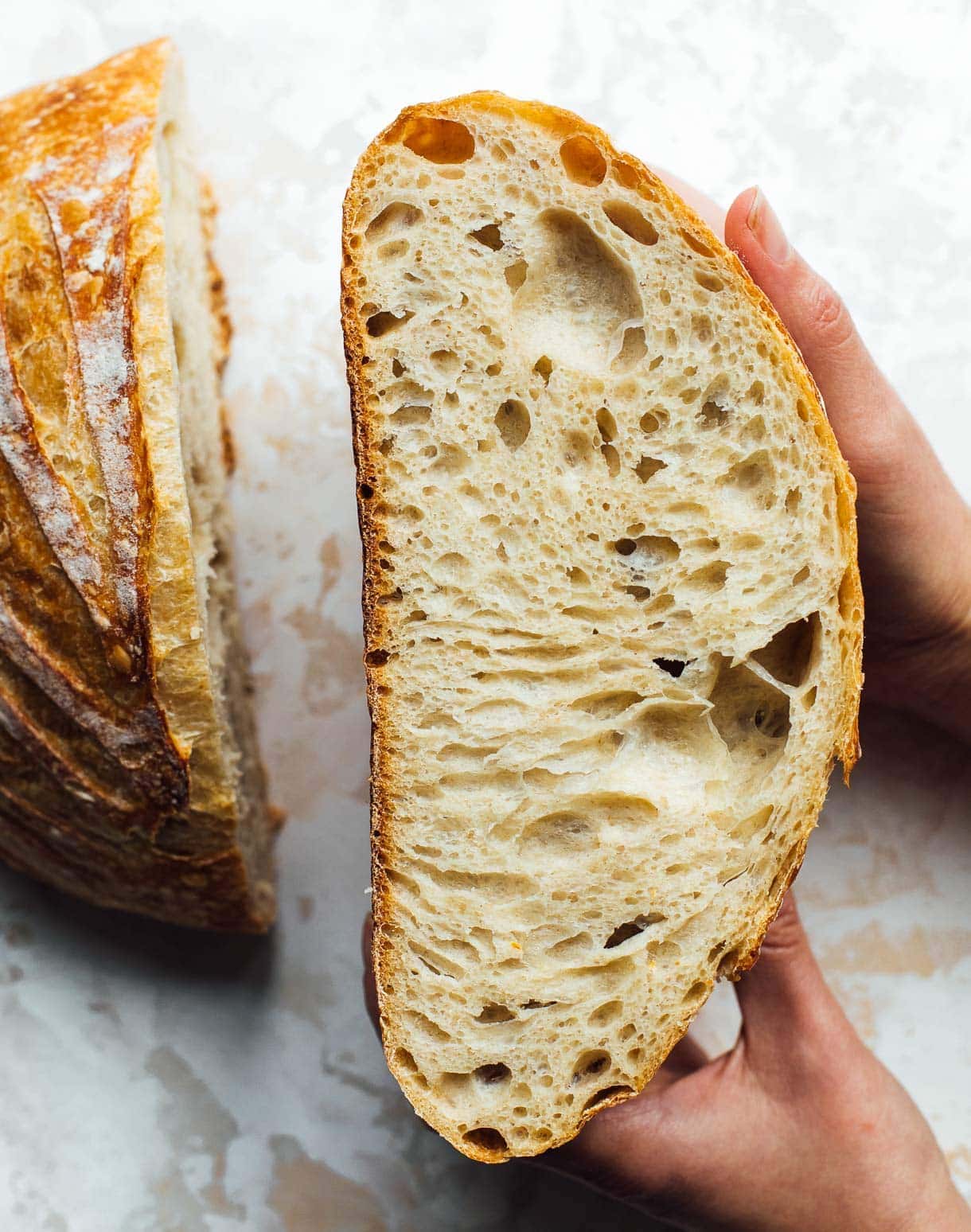
Delicious Everyday Sourdough Bread Recipe
A naturally fermented sourdough bread that has a fluffy interior and golden brown crust. This is a great recipe for sourdough beginners, and walks you through the entire process of making a basic sourdough bread.
Yield: 1 loaf
Ingredients
- 50 grams active sourdough starter
- 305 grams filtered water at temperature, around 85 to 90 degrees F
- 370 grams bread flour
- 30 grams whole wheat flour*
- 7 grams fine sea salt
Equipment
Instructions
- In a large bowl, mix starter and water with a fork, until starter is dispersed. Add flours, mixing with a spatula first. Then with your hand until a shaggy dough is formed, just enough so that flour is not visible.
- Cover with a damp cloth and let sit for 30 minutes.
- Once rested, add salt to top of dough and liberally knead the dough for two minutes. Then perform your 1st of stretch and folds. Let rest for 30 minutes.
- Then perform your 2nd set. Let rest for 30 minutes. Then perform your 3rd set. Let rest for 30 minutes. Then perform your 4th and final set. Here is a video of how to do a stretch and fold. It is easy!
- After those stretch and folds are completed, you will let the dough go through its long proof (rise) in a bowl or my preferred vessel, a tall sided bucket so I can tell how much the volume is increasing. on the counter - this stage also known as the bulk fermentation. You are looking for your dough to be finished proofing when: it has until just about doubled in size, like a 85 to 95% increase, has a glossy look to the top, is slightly domed on top, and a bubble or two will be poking out the edges of the time. It should jiggle a bit as well when you shake it. These are the signs to look for, rather than going off of time. A specific length of proofing time cannot be given because the temperature of water you used and air temperature in your home will be different for everyone, and will also be different for you every time you bake. If your house is between 72 to 76 degrees F, that is ideal for the wild yeast to be happy and the double will rise quicker than if it cooler in your home. That means sometimes it might take 6 hours to finish proofing, maybe in summer, and over 10 hours in the depths of winter.
- After the bulk fermentation is finished, you'll gently move the dough out of the bowl onto a floured work surface. Let the dough rest there for 10-15 minutes.
- Then, shape the dough. You can watch the video below to learn how to shape it into a round boule.
- Once shaped, use a bench scraper to put the dough into a banneton (proofing basket) that has been liberally dusted with rice flour, seam side of the dough facing up (so the top of the dough is what is touching the bottom of banneton) when it is placed in banneton.
- For best results, I like to do a cold final proof in the refrigerator, overnight. Put the banneton with dough, in a plastic bag or covered with a shower cap (this ensures the dough will not dry out) in the refrigerator and let the final rise happen. You can bake ANYTIME the next day. OR you can do the final proof on the counter, covering with a damp cloth. You are looking for about a 15% rise in the dough, and or it to puffy on top. This is typically between 1 to 2 hours, depending on the warmth of your home.
- Once your dough is finished proofing, preheat your oven with dutch oven in it to 450 degrees F. (Keep the dough in the refrigerator if you did the overnight rise, until is preheated. Cold dough is much easier to score than warm dough, and you also don't want to let it proof more at room temperature.)
- Wait until oven is preheated, then place parchment over the top of your banneton with dough in it and flip over, so that the seam side is now on the parchment paper and you are able to score the top of the dough.
- Score the dough with a bread lame, making sure to go at least 1/2 inch deep in a few spots so that dough can release gases. Otherwise your bread will not rise.
- Place dough on parchment paper into a dutch oven, and put cover on it. Bake for 20 minutes, covered at 450 degrees F. Then remove cover, turn heat down to 425 degrees F, and bake for 25 more minutes, until bread is golden brown and crackly.
- Remove from oven and place load on a cooling rack. Let cool for AT LEAST ONE HOUR before slicing. Otherwise the crumb will be squished and the texture will be gummy.
Notes
*You can also use whole grain einkorn, spelt, red fife, or khorasan flour.
